The UK.D-I-Y Frequently Asked Questions
HEATING AND PLUMBING
Central Heating Controls, Motorised Valves and Wiring

Back to Contents Page
 

Central Heating Controls, Motorised Valves and Wiring


Heating Systems

Other Plumbing


Corrections? Please email the FAQ maintainer.
Questions? Please see the FAQ Introduction.


Back to Contents Page

Top


CENTRAL HEATING CONTROLS, MOTORIZED VALVES AND WIRING

Originally written by Ed Sirett 20/11/1996. Modified/added to by Matthew Marks: 29/10/1998. Modified/added to by Ian Clowes: 26/10/2000

Introduction

Conventional central heating (CH) systems that also have an indirect hot water (HW) storage cylinder usually have a control system comprised of the following parts:

1) A programmable time-switch

2) Valve(s) (frequently motorized) to control separately the CH and HW

3) Room and/or cylinder thermostats.

If you have a direct HW cylinder then what follows won't be right for you, unless you intend changing that cylinder. Direct means the water in the cylinder is heated by actually passing through the boiler. The cylinder is simply a store of hot water. With an indirect cylinder there is a coil of pipe in the cylinder, and this acts like a CH radiator to transfer heat from the boiler to the water in the cylinder, so the cylinder is where the heating actually takes place as well as being a storage vessel. Indirect cylinders have a cold water feed into the bottom, and supply HW to the house from the top. The coil in connection is about half way up the tank and the coil out near the base.

Its important to realise that the level of control you have over your heating and hot water is due to a combination of the plumbing system and the programmer. If you have a simple programmer you may need to change it and the plumbing to get a more flexible system. However, you may be lucky and just need to pop a new programmer in place if a full set of valves is in place.


Back to Contents Page

Top


The Time-Switch

The time-switch may be electromechanical or fully electronic. Electromechanical means you'll see a timer wheel turning and pushing against contacts, whereas with fully electronic there'll be a digital time display. A surprising range of electromechanical time-switches are still available, and they can be easier to understand/program for certain elements of the population.

A programmer that has a single switched output is commonly called a time-switch. A programmer that has two switched outputs but only allows CH to be selected if HW is selected is often called a mini-programmer. A programmer that allows you to turn on HW and CH independently is simply termed a programmer.

You may see these names in manufactures literature and merchants catalogues. In conversation you'll find the terms bandied around in a more casual, non-specific way, just like we do in the rest of this document!

Note that a programmer may allow you to select HW and CH independently (i.e. none, any one or both on), but the timing may be 'common' or 'independent'. With a common time base if both are set to come on/go off they do so at the same time. With an independent timebase you really do have full flexibility.

Some systems (because of limitations in the installation) can't have CH independently from the HW, and this is usually reflected in the control, so that as you move the CH control to off then the HW control also moves. This is usually referred to as "ten" mode, because there are ten different valid combinations available of "off, twice, once, on" for heating and water. It may also be described as "gravity" mode, referring to gravity-operated circulation to the hot water cylinder (convection). The fully-independent configuration is thus "16" or "pumped" mode. The actual number of these modes that you can select is limited by your programmer.

A programmer can have different settings for each day of the week, and is called a 7-day programmer. A programmer that allows you to specify one schedule for Mon-Fri and a different one for Sat-Sun is called a 5/2 programmer. Simple programmers use the same timings every day and are called 24-hour programmers.

Almost all programmers can have at least two separate ON periods for each 24 hours. Some have three or more.

You may find an arrangement where there is a time-switch and an additional, external switch (maybe like a light switch) in the time-switched circuit that you flick to get CH when the timer is on. The switch may be in a place pretty remote from the time-switch. This arrangement is effectively the same as a mini-programmer.

In some instances you may wish to run different parts of the building's central heating on different timings. If you only need three circuits (HW/CH1/CH2) then three channel programmers are available to do this, although you may prefer to use programmable thermostats in each zone. If you want even more zones (say a Granny flat, garage and attic room) then adding additional, remote time-switches or programmable thermostats is probably the way to go. Once again, you'll also need an appropriate plumbing arrangement to be able to isolate the zones with valves.

The programmer produces signals which say 'I want HW' or 'I want CH'. An ON signal in this context is a wire which is connected to the 230V mains supply. For fully independent control using a 3-port valve, an additional 'I don't want HW' signal is needed.


Back to Contents Page

Top


The Valves

On some very basic installations there might simply be a hand valve which when opened lets the CH radiators become warm. Such installations will have a simple time-switch to control the boiler and pump. The user opens the CH valve for winter and closes it for summer (hence providing HW only). Most installations have at least one motorized valve, which will enable the CH to be switched automatically whilst still allowing the system to produce HW.

Motorized valves come in two flavours: 2-port, known as 'zone valves' (a simple open/closed piece of pipe), and 3-port (a fully controlled T-junction).

There are two varieties of 3-port valve, mid-position and diverter. With a mid-position valve the middle port is connected to flow from the boiler and the water is directed to port 'A', 'A and B' or 'B' as requested. With a diverter the boiler flow goes to either 'A' or 'B', but never both. Alternative names for these valves are (respectively) 'Y-plan' and 'W-plan', after the names Honeywell give to them under their Sundial Plan system.

If the idea of heating different areas of the house in different ways interests you then you'll need to look at 2-port valves for each zone. Doing this sort of thing with 3-port valves gets very complicated.

Valves generally come in two parts: a plumbing part and a removable motorized head. On some early models it is not possible to replace the head independently from the rest, and the system has to drained down to replace them. The electrical part is a _relatively_ unreliable component, hence the desirability of a 'replaceable head'.

Valves generally have a lever that can be latched in a position to allow water to flow. This is necessary when filling or draining the system, and can be used to permit heat to circulate if the motor fails. The latched lever should automatically unlatch once the motor operates.

Whilst colour coding of the wiring may vary from one model and manufacturer to the next most models seem to follow the following schemes (data for the diverter valve is required):

COLOUR 2-PORT MID-POSITION
Green/Yellow Safety Earth Safety Earth
Blue Neutral Neutral
Brown Opens valve when live Not used.
Orange Common pole of switch. Go fully to 'B' when live.
Grey Connected to common when open. Live when at 'AB' or 'B'
White  [Connected to common when closed.]  Go to 'AB' or 'B'.

Some 2-port valves don't have a white wire. The mid-position valve reverts to position 'A' when there are no electrical inputs. The 2-port valve reverts to closed.

There are some older two-port valves of a different type (large plastic head) which are not mechanically interchangeable with the modern valve bodies, and may be electrically incompatible too.


Back to Contents Page

Top


Thermostats and TRVs

Wall thermostats, when fitted, are in series with the CH signal from the time-switch. Some have a built in resistor ("accelerator heater") to reduce the hysteresis, i.e. the "backlash" in temperature between switching on and switching off. When the thermostat is on, the resistor supplies a minute amount of heat, which makes the thermostat think that the room is slightly warmer than it is, and therefore makes it switch off again earlier. The room temperature will thus fluctuate less. Such thermostats require 3 cores and earth: live, switched output and neutral for the resistor. If live and switched output are interchanged, the resistor will be powered constantly and the advantage will be lost. Simpler/older thermostats only need 2 cores and earth, so if you're replacing a thermostat you might want to check the wiring beforehand to see if you can use this feature.

Wireless thermostats are available, which use radio waves to communicate with the rest of the system. These can be convenient if you wouldn't otherwise be able to site the thermostat in a sensible place because of the wiring. Such devices are battery powered, and this will need replacing periodically. One potential advantage of wireless thermostats is that you can move it around the house with you, ensuring the room you're occupying is the one you're using to determine whether heat is needed.

Some room thermostats are available with timers in that allow different target temperatures to be set for different times of the day or week. 6 different temperatures over a 24-hour period is not unusual, so these give a much greater degree of control over the heating system. An 'optimisation' version is usually available. This will predict when the heating needs to be turned on in order to achieve the target temperature. For example, if you program a desired temperature of 21deg for 7am the thermostat might decide it needs to turn the heating on at 6.30am on one day, but at 6am on another (colder) day.

Unfortunately, room thermostats effectively control the whole CH system by monitoring a single point in the house, and so TRVs (Thermostatic Radiator Valves) are an advantage since they control each radiator. Earlier models tend to have the habit of sticking on or off and have given TRVs a bad name. For some valves it is important that they are installed with regard to the direction of water flow. Some valves don't have this restriction. Some angled valves can be fitted with the head vertical or horizontal, so you can always get the correct flow direction through them.

If all radiators have TRVs, some sort of bypass arrangement must be made, to prevent circulation through the boiler ceasing if all valves close down. The bathroom radiator/heated towel rail may not have a TRV (reasoning being that the heat is needed to dry towels even if the room is warm enough), or there may be a separate bypass loop, controlled by a gate valve, and some distance from the boiler so that there is a reasonable volume of water (and hence a reasonable heat sink) circulating. You may also find a 'pressure detecting' valve that will open up as the TRVs close down.

The cylinder thermostat (tank-stat) is an effective device which switches off the HW when the storage cylinder is fully heated. They can only be used on systems which can CH independently from the HW. (On other systems, a thermostatic valve can be fitted, taking note of the bypass arrangements detailed above - in this case the bathroom radiator may be plumbed in to operate all the time.)


Back to Contents Page

Top


Installation Types

Installations generally fall into one of four categories:

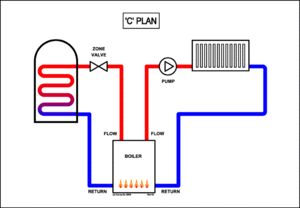
A) Gravity HW and optional pumped CH

B) Fully pumped system with a 2-port valve for optional CH

C) Full control by two 2-port valves

D) Full control by a 3-port valve

There are several variations on (A) to add valves and thermostats, hence giving more control to a gravity HW system, one of which is called C-Plan by Honeywell.

The following table shows some common names for (C) and (D). Note that the table gives names for (D) with a mid-position valve. With a diverter valve Honeywell call this W-Plan.

Manufacturer Type C Type D
Honeywell S-plan Y-plan
Danfoss Randall Heatplan Heatshare
ACL Drayton TwinZone BiFlow
Landis & Staefa ZoneMinder FlowMinder

Although any installation may be the right one for you the following notes may help you choose a particular one, if you have the choice.

With gravity systems you may find some of your radiators getting warm even when the CH is off unless there is a valve to prevent the water finding a route into the CH circuit.

Pumped circuits get heat from the boiler to the cylinder more quickly, reducing the time taken to reheat the cylinder.

W-plan systems can leave you without CH for some time since they can provide heat to only one of HW or CH at any given moment. Usually HW is given priority, so if you run a bath all heat will be diverted to the HW for as long as it takes to reheat the water. If several people have fresh baths or showers (particularly power showers) in succession you may be without CH for an hour or more. This effect can be reduced by fitting a fast recovery cylinder (which has a more efficient heat exchanger and therefore heats up much quicker). People have been known to be so dissatisfied with a W-plan installation that they have had it converted to Y-plan.

Mid-position valves have 'worse' failure modes (see below) than 2-port valves. However, a single mid-position valve is cheaper than a pair of 2-ports.


Back to Contents Page

Top


Wiring

Manufacturers produce 'wiring centres' to help get all the wiring done correctly. Some of these are simply 10- or 12-way connector blocks, with suitable notes on which colour wires go to which numbered connector.

Other wiring centres work on the principle of having a separate terminal block for each component (boiler, pump, valves, thermostats, etc) mounted on a PCB. You wire each component to the correct terminal block, and then cut some link wires on the PCB to create the installation you actually require. This type is arguably easier to use, but has the limitation that you can only easily implement certain common arrangements, usually (C) and (D) from above, plus some variation on (A).


Wiring for (A):

The HW signal goes to the boiler. The CH signal goes to the pump. The water is circulated to heat the HW cylinder by the difference in density between hot and warm water usually pipes of at least 28mm are used. The CH comes on when the pump is started. A room thermostat may be fitted in series with the pump. The timer is configured not to produce a CH signal without the HW signal.


wiring for (B):

The boiler and pump are connected to the HW signal. The CH signal is connected to a motorized zone valve (2-port type) which opens to allow water to circulate through the radiators: the brown wire on the valve (possibly via a wall stat). Grey/Orange/White probably not connected. The timer is configured not to produce a CH signal without the HW signal.


Wiring for (C):

The CH signal goes through a wall stat if fitted the HW signal via a tank stat if fitted. Each signal then goes to the brown wire on its respective 2-port valve. The grey wires on the valves are connected to the mains live (permanently), and the orange wires are connected to the pump and boiler. Since zone valves can and do fail, the power to the boiler is cut off in the case where both valves are closed (for whatever reason), since it would be a "Bad Thing" for the boiler to fire up with no circulation occurring.


Wiring for (D):

Note :  It turns out that the manufacturer, Honeywell, advise that the A port should be connected to the central heating circuit and the B port to the HW heating coil (the opposite of the first sentence below. Therefore the following description needs re-writing to reflect this (any offers?) 

In this set-up I am assuming that the A-port of the valve is connected to the indirect heating coil inside the HW cylinder, and the B port to the central heating radiators. Of course it can be installed the other way around, in which case all the following still applies but with the CH and HW switched and the tank and wall thermostats exchanged. The wall stat instead of the tank stat will then need a changeover contact. This arrangement will consume slightly more electricity (because the valve is more likely to sit energised for long periods) and will require four core plus earth cable to the room stat, if it has an accelerator heater.

PROGRAMMER                VALVE
OUTPUTS:                  CONNECTIONS:
                    /
    CH wanted 0----o o-------White
                room stat
 
    HW wanted 0----
                  |            Orange<--
                  o                    |
                  / tank stat          |
                o/  o---------------------OBoiler/pump
                |
HW not wanted 0--------------Grey
 

The diagram shows the live connections to the valve. Both stats are shown in the "satisfied" position. Neutral will connect to the boiler and pump, the blue wire on the valve, and the accelerator heater on the room stat (with the other end of the heater connecting to the white wire). Everything requiring it should be earthed, of course!

The 'I want HW' signal from the timer goes via the tank stat to the boiler and pump. If only hot water is required, no power is supplied to the valve and it will open port A. (The orange wire is an output, and does nothing at this point.)

 The 'I want CH' signal goes via the room stat to the white wire on the valve. If hot water is also required, the grey wire will not be live, the valve will wind to the middle A+B position, and the boiler/pump will be supplied from the 'I want HW' signal as before.

 If, however, hot water is not required OR the tank stat indicates that the cylinder is hot enough, the grey wire will also be energised, and this will wind the valve to the B position. The *valve* will then supply the boiler/pump via the orange wire.

Back to Heating Page

Top

 
Last modified: 15 May, 2006 19:25:17
UK.D-I-Y FAQ Maintainer: Phil Addison (editor@diyfaq.org.uk)    © Copyright 2001, 2002, 2003, 2004,2005